

Change Talk in the Medication Visit – Elicit, Reinforce, Reflect

Medication visits are often brief—but even in 10 minutes, prescribers can shift outcomes by evoking Change Talk.
Change Talk is any speech that favors movement toward change. When prescribers elicit, reflect, and reinforce it, they increase motivation and reduce ambivalence. This article teaches prescribers how to:
Identify and shape Change Talk in under 60 seconds
Use strategic openers during medication conversations
Integrate motivation-building without derailing clinical priorities
Types of Change Talk
Use the DARN-CAT acronym to quickly identify types
Desire – “I want to quit.”
Ability – “I think I could do it.”
Reasons – “It’s affecting my health.”
Need – “I have to change.”
Commitment – “I’m going to call them.”
Activation – “I already skipped one cigarette today.”
Taking steps – “I walked yesterday instead of drinking.”
Quick Visit Integration: Elicit → Reflect → Reinforce
Try this 3-step formula:
1. ELICIT
“Please tell me your sense of how the medication is helping—or not”
“Please tell me where you are in terms of making this change we talked about.”
2. REFLECT
“You’re seeing some benefits but still unsure—it makes sense you’d feel that way.”
“You’re sticking with it even though it’s hard. That says a lot.”
3. REINFORCE
“That willingness to keep trying—that’s strength.”
“Saying it out loud helps lock it in—change happens one step at a time.”
Printable Tool: Change Talk Tracker (for Clinician Use)
Use during or after a visit to capture motivational moments:
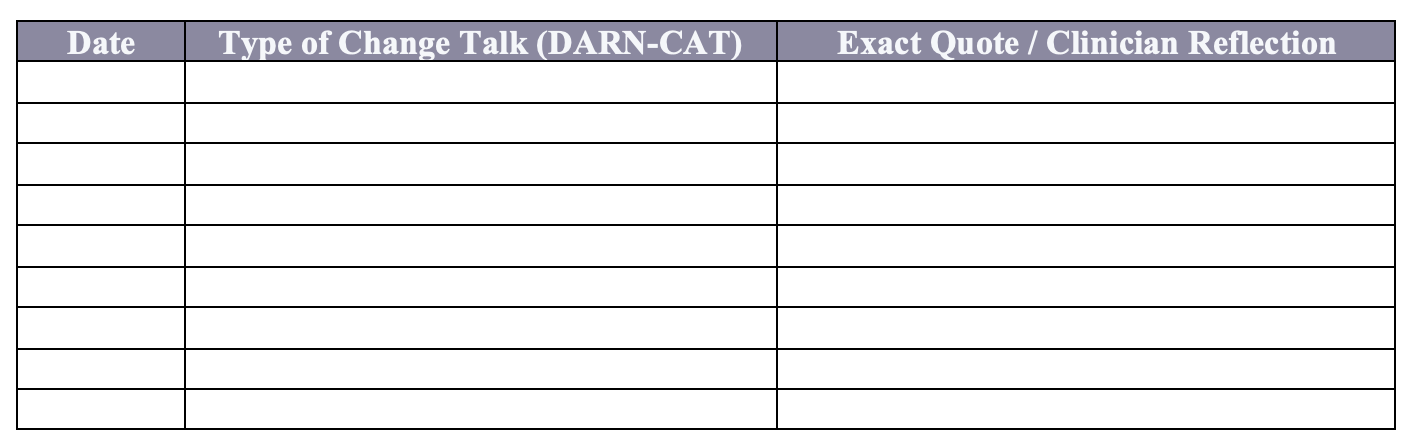
Reflection for Prescribers
☐ Am I listening for the change beneath the complaint?
☐ Do I reflect motivation, not just problems?
☐ Do I honor each step, however small, as success?
Scientific Reference
Change Talk has been shown to predict behavior change across addictions, health behaviors, and medication adherence.
Amrhein et al. (2003). Journal of Consulting and Clinical Psychology.
Moyers et al. (2009). Psychology of Addictive Behaviors.
Miller & Rollnick (2012). Motivational Interviewing, 3rd Edition.
Coming Up Next
In the next Article, we’ll explore how to use micro-assessments at the start of visits to rapidly identify the current stage of change—and avoid wasted time.
Scientific References
Amrhein, P. C., Miller, W. R., Yahne, C. E., Palmer, M., & Fulcher, L. (2003). Client commitment language during motivational interviewing predicts drug use outcomes. Journal of Consulting and Clinical Psychology, 71(5), 862–878. https://doi.org/10.1037/0022-006X.71.5.862
Moyers, T. B., Martin, T., Houck, J. M., Christopher, P. J., & Tonigan, J. S. (2009). From in-session behaviors to drinking outcomes: A causal chain for motivational interviewing. Journal of Consulting and Clinical Psychology, 77(6), 1113–1124. https://doi.org/10.1037/a0017189
Miller, W. R., & Rollnick, S. (2012). Motivational Interviewing: Helping People Change (3rd ed.). Guilford Press.