

Breaking Through Inaction – Helping Patients Start

Understanding the Action Barrier
Many patients stall between preparation and action, not because they lack desire, but because action is psychologically and neurologically expensive. The brain resists uncertainty and energy-intensive behavior changes (Kahneman, 2011).
The Neuroscience of Initiating Action
Behavioral activation involves the dorsolateral prefrontal cortex and basal ganglia. Initiating a new action requires executive function and motivation circuits to override the limbic system’s comfort bias (Graybiel, 2008).
What Keeps People Stuck?
Fear of failure or discomfort
Perfectionism ('I have to get it all right')
Lack of confidence or visible success models
Belief that small actions 'don’t count'
Tool: The 'Starter Step' Exercise
Ask:
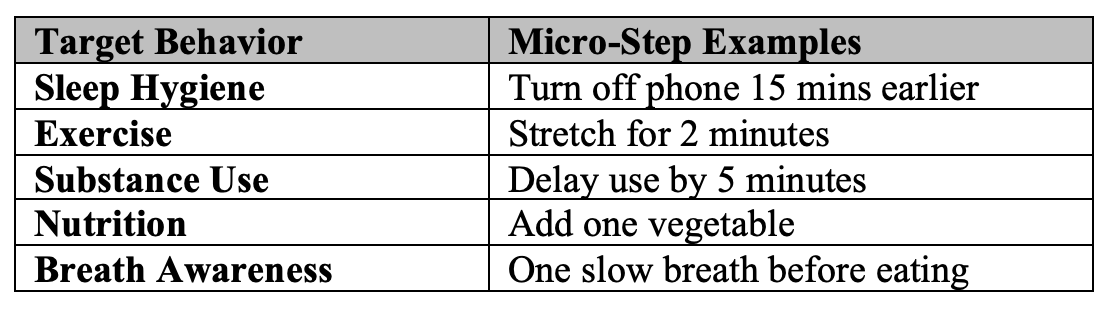
'Tell me what is the smallest next step you could take today.' (e.g., throw away one cigarette)
'Tell me what would a 2-minute version of this behavior look like?'
Reinforce: 'Action creates clarity, not the other way around.'
Quick Prescriber Scripts
'Don’t wait for motivation—motion creates emotion.'
'Tell me one thing you could do today, even if it’s tiny'
Behavior Activation Table
Scientific References
Kahneman, Daniel. Thinking, Fast and Slow. Farrar, Straus and Giroux, 2011.
Graybiel, Ann M. “Habits, Rituals, and the Evaluative Brain.” Annual Review of Neuroscience, vol. 31, 2008, pp. 359–387, doi:10.1146/annurev.neuro.29.051605.112851.